SIGMA 200mm F2 DG OS
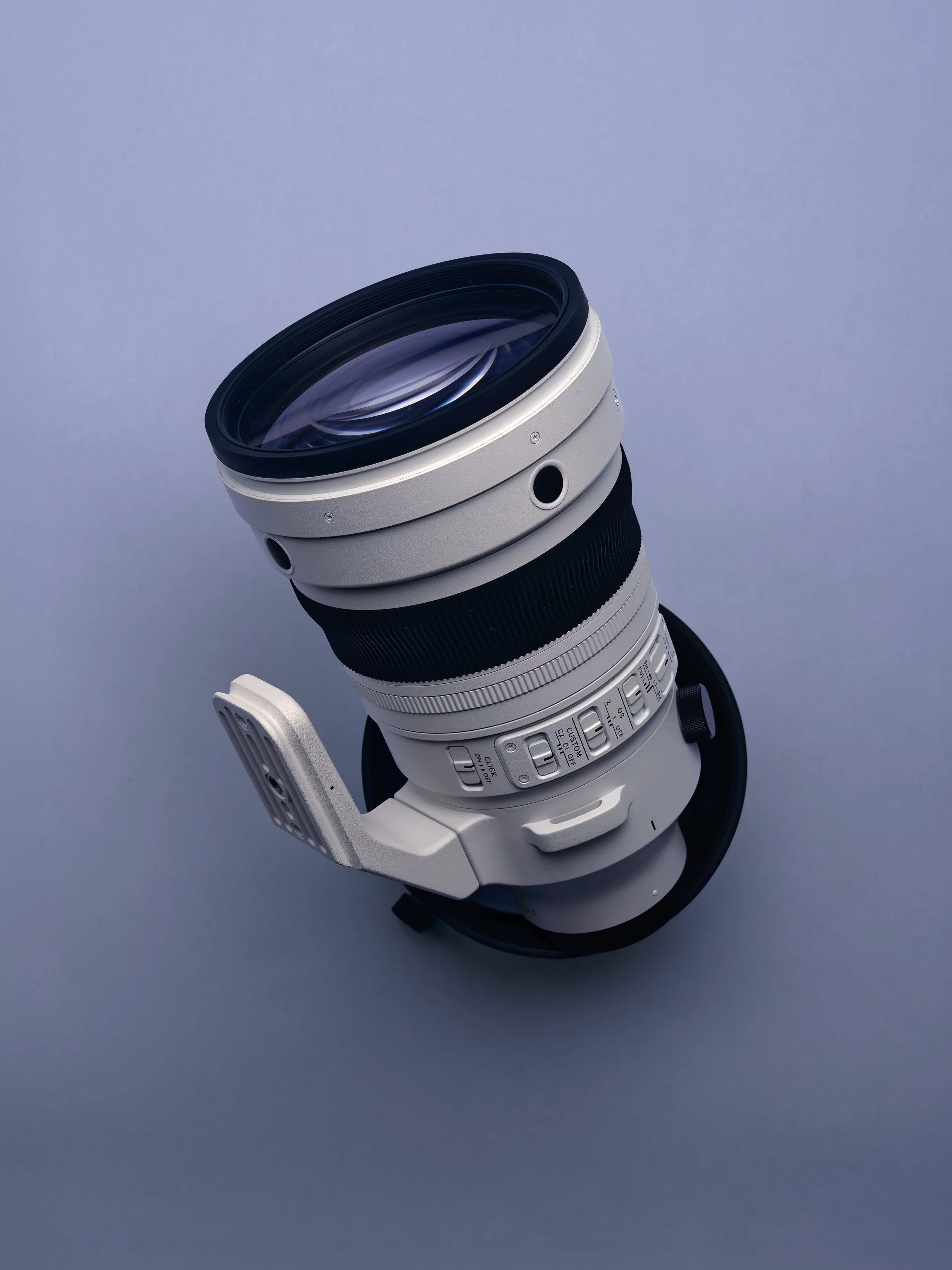
SIGMA 200mm F2 DG OS | Sports
The lens you don't need. Until you use it.
Some lenses are easy to justify.
A 24-70mm or 70-200mm F2.8 will cover an extraordinary number of situations. Sony’s 50-150mm F2 GM goes even further by combining the flexibility of a zoom with an F2 aperture.
A 200mm F2 prime is different.
It is big, heavy and expensive. It gives you one focal length and, depending on what you photograph, 200mm can be either too long or not quite long enough. It is hardly discreet, and it will take up a significant part of your camera bag.
And yet, a 200mm F2 has been on my list of dream lenses for years.
Not necessarily the lens I could easily justify buying, nor the one I would use every day, but one of those slightly unreasonable pieces of photographic equipment I have always wanted to own. Perhaps one day I will.
Part of that fascination comes from the images I had seen from the old Canon and Nikon 200mm F2 lenses. There is something about the combination of 200mm and F2 that is difficult to reproduce with anything else. So, when Sigma Deutschland offered me the opportunity to use its new 200mm F2 DG OS | Sports for two weeks, I didn't have to think very long.
I was curious for two reasons.
First, because Sigma describes this as the world's first 200mm F2 lens designed specifically for full-frame mirrorless cameras. Canon and Nikon produced their own 200mm F2 lenses in the DSLR era, but both were enormous pieces of glass. Sigma has managed to revisit the concept in a significantly lighter package.
But mostly, after years of looking at 200mm F2 lenses from a distance, I finally wanted to find out whether the reality lived up to the idea I had built around them.
It did. And that is where the trouble starts.
Disclaimer
The lens for this article was kindly loaned to me for two weeks by Sigma Deutschland. Sigma did not pay me, impose any editorial conditions or exercise any right of approval over my work. The company did not read this article before publication.
All photographs in this review were taken with a Sony A7R V.
Bringing the 200mm F2 into the mirrorless age
A 200mm F2 is not a new idea. Canon had the EF 200mm F2L IS USM and Nikon the AF-S Nikkor 200mm F2G ED VR II. Both acquired something close to legendary status, particularly among sports and portrait photographers. They were also enormous.
Canon's lens weighed around 2.5 kg. Nikon's was closer to 3 kg. Sigma's new 200mm F2 weighs 1.8 kg in Sony E-mount and measures just over 20 cm in length.
Calling a 1.8 kg lens lightweight would obviously be ridiculous. Put it next to a normal prime and it is still huge. But compared with what a 200mm F2 used to be, 1.8 kg is a considerable achievement.
The same applies to price. At around €3,500, nobody is going to call the Sigma cheap. But this type of lens traditionally occupied a considerably more exotic price category. That is probably Sigma's first achievement here. It hasn't made the 200mm F2 small, light or inexpensive. It has made it smaller, lighter and more attainable than it has ever been before. Taken together, the combination of price, weight, size and performance is difficult to match.
It still looks and feels like a 200mm F2
There is, however, no hiding what it is. The 105mm filter thread is huge. The lens is white. Add the hood and mount it on an A7R V and you have a camera that gets noticed. In 2026, when most photographs are taken with smartphones, walking through a city carrying something like this attracts a few looks.
I did it anyway. A lot, actually.
Surprisingly, I never found the weight itself particularly problematic during my two weeks with the lens. You obviously know that you are carrying 1.8 kg, but Sigma has got the balance right. There is also a small detail that made a bigger difference than I expected: the tripod foot is relatively long. It effectively becomes a handle, and I regularly carried the complete A7R V and 200mm combination by it while walking around Munich. It sounds insignificant. With a lens this size, it isn't.
And there is another benefit Sigma doesn't mention prominently enough in the specifications. Use the 200mm handheld for street photography during several long walks through Munich and it doubles as a remarkably effective fitness programme. By the end of the two weeks, I wasn't entirely sure whether I should return the lens to Sigma or send them my gym membership cancellation. So yes, Sigma has performed a small engineering miracle by bringing a 200mm F2 down to 1.8 kg. Your arms will nevertheless remind you that 1.8 kg is still 1.8 kg.
Sigma build quality in 2026
There was a time when buying a third-party lens meant accepting compromises in exchange for a lower price. That argument feels increasingly outdated.
The 200mm follows Sigma's latest design language and the quality of construction is excellent. The focus ring, aperture ring, switches, tripod collar and hood all feel properly engineered. Nothing feels like the place where Sigma decided to save money. This is something I have noticed increasingly with recent Sigma products. The company is no longer simply producing alternatives to lenses from Sony, Canon, Nikon or Fujifilm. In terms of construction, design and overall feel, its best lenses now comfortably belong in the same conversation. The 200mm reinforces that impression.
It belongs to Sigma's Sports line and has the protection expected from a professional telephoto, including a dust- and splash-resistant structure, a water- and oil-repellent front coating and Sigma's heat-insulating exterior coating.
Inside are 19 elements in 14 groups, including two FLD and two SLD elements, with an 11-blade diaphragm. Minimum focusing distance is 1.7 metres. Autofocus is driven by Sigma's HLA linear motor and the optical stabilisation system is rated at 6.5 stops.
Those specifications matter. But they aren't really why you buy this lens.


Then you shoot at F2
Anyone who has previously used a 200mm F2 will probably understand this immediately.
There is a very particular look to the images.
It isn't simply about producing more background blur. Combine 200mm compression with F2 and enough distance between your subject and its surroundings, and backgrounds can almost disappear.
The butterfly photograph is a good example. The subject remains remarkably well defined while everything around it progressively dissolves into areas of colour and light. The same thing happens with the swan, although in a completely different setting.
What I like about the rendering is the transition. There is a sense of depth between the sharp and unsharp parts of the photograph rather than the impression of a subject simply being pasted onto a blurred background. And yes, it becomes addictive. After a while I found myself actively looking for scenes where I could exploit it. That is usually a good sign.
F2 actually means F2
I used the Sigma exclusively on the 61-megapixel A7R V, which isn't particularly forgiving of mediocre optics. There is little to worry about here.
The 200mm is extremely sharp at F2. More importantly, I never felt that I needed to stop down to get the best out of it. That matters. There wouldn't be much point in buying and carrying a 200mm F2 if its maximum aperture were something you tried to avoid. F2 is the reason this lens exists and it is perfectly usable there.
I also found the rendering very clean. Chromatic aberrations are extremely well controlled, contrast is excellent and the lens has no difficulty resolving the A7R V sensor. But sharpness isn't what stayed with me after two weeks. The rendering did.
Autofocus: nothing “third-party” about it
This was one area where I wasn't entirely sure what to expect.
Not because recent Sigma lenses have poor autofocus (far from it) but because there can still occasionally be a subtle difference between a lens that works well on a camera and one that feels completely integrated with it. With the 200mm on the A7R V, I simply forgot about it.
AF was fast, decisive and extremely reliable. Sony's subject detection and tracking behaved as I expected them to and at no point did I have the feeling that I was using a third-party lens.
The best example came completely by accident.
I saw a dragonfly flying above the water and decided to try following it. A dragonfly is not exactly the easiest autofocus target. It is tiny, fast, changes direction constantly and is considerably less predictable than a person, dog or even most birds. Following one handheld through a 200mm lens isn't particularly easy either. Yet the A7R V and Sigma managed it. I got the photograph. That tells me considerably more about the autofocus than photographing a test target ever could.
Stabilisation: very good, and genuinely useful
The stabilisation was equally convincing.
Almost everything I photographed during those two weeks was shot handheld.
At 200mm, stabilisation isn't only about getting a sharp photograph at a slower shutter speed. A stable viewfinder image also makes precise framing much easier, particularly when working with architecture and small details.
I found the system extremely effective. There is one interesting comparison with my Sony 50-150mm F2 GM, however. In darker environments, I had the impression that the Sony gave me a slight advantage. In practice, I seemed able to keep the ISO a little lower with the 50-150mm, resulting in cleaner files.
I didn't test the two lenses side by side under controlled conditions, so I wouldn't read more into this than intended. It is simply something I noticed while shooting.
For everything else, the Sigma's stabilisation left me with very little to complain about.

Architecture.
That was unexpected.
I didn't borrow a 200mm F2 to photograph architecture. And yet architecture became one of my favourite things to photograph with it.
The obvious choice for architectural photography is usually something wider. That makes sense when the objective is to photograph a building. But architecture can also be about extracting details from a building. For that, 200mm is fascinating.
You need distance, obviously. In a narrow street it can simply be impossible to get the composition you want. Give the lens enough space, however, and it becomes a remarkably precise compositional tool.
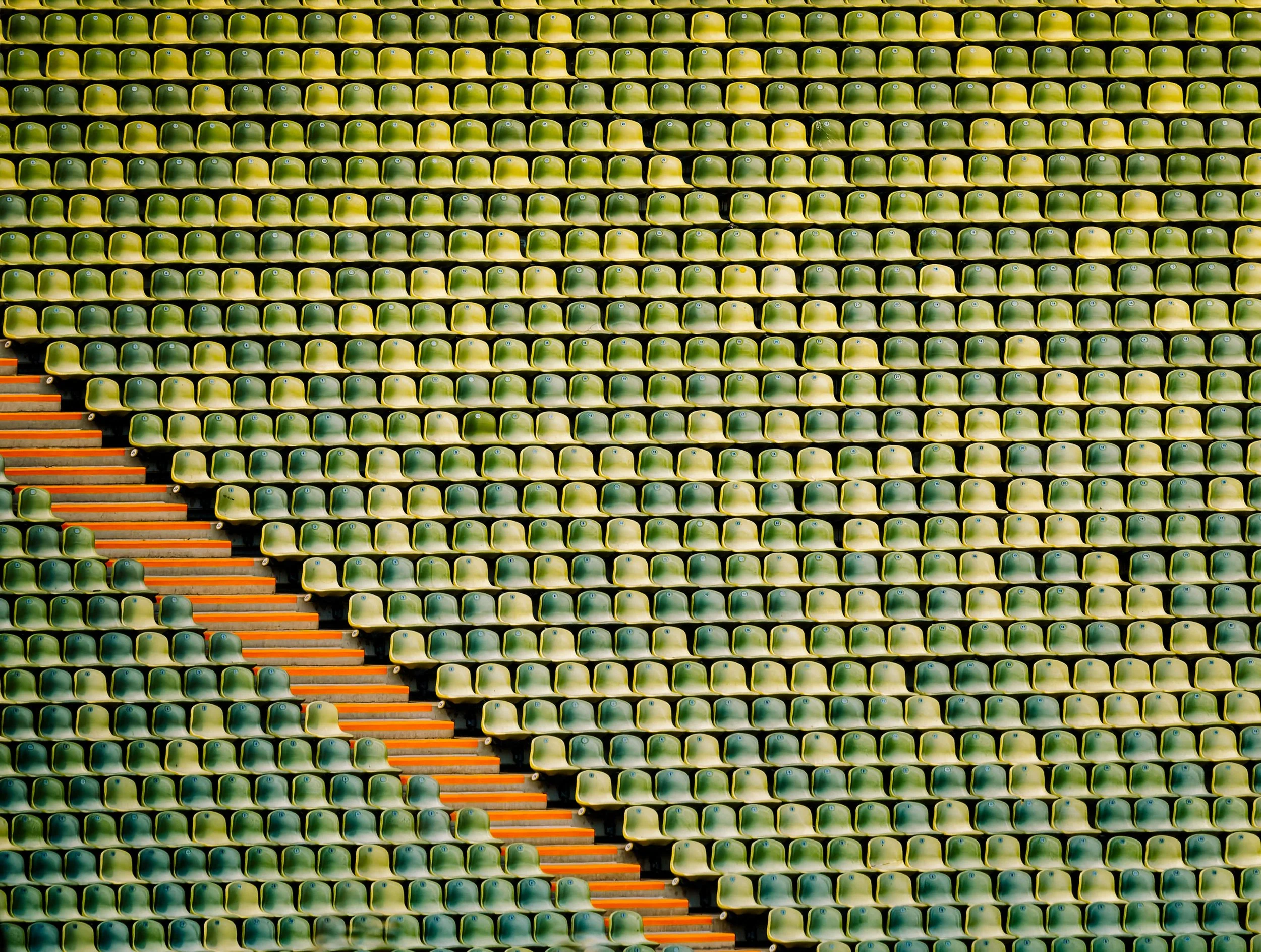
The photograph of the empty stadium seats is probably the simplest example. What interested me wasn't the stadium itself but the repetition of hundreds of seats interrupted by that orange staircase. At 200mm, everything unnecessary could simply be excluded.

The same thing happened around Munich's Olympic Park.
From the right position, the 200mm allowed me to bring the BMW headquarters visually much closer to the structure of the Olympic Stadium. Two separate pieces of Munich architecture suddenly became part of the same composition.
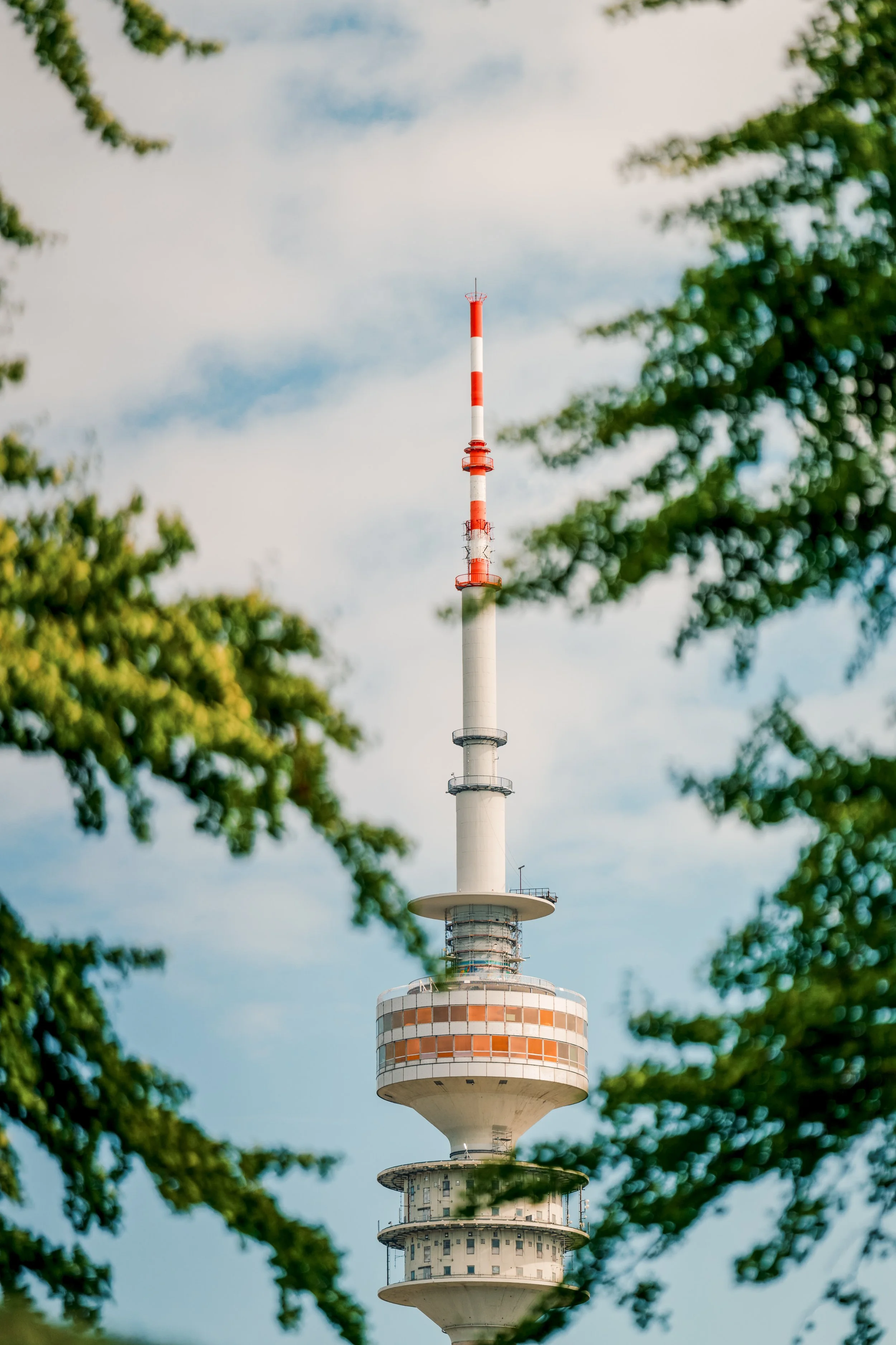
With the television tower, foliage could be used to frame and isolate the structure. Elsewhere, façades became collections of arches, columns, colours and repeating lines.
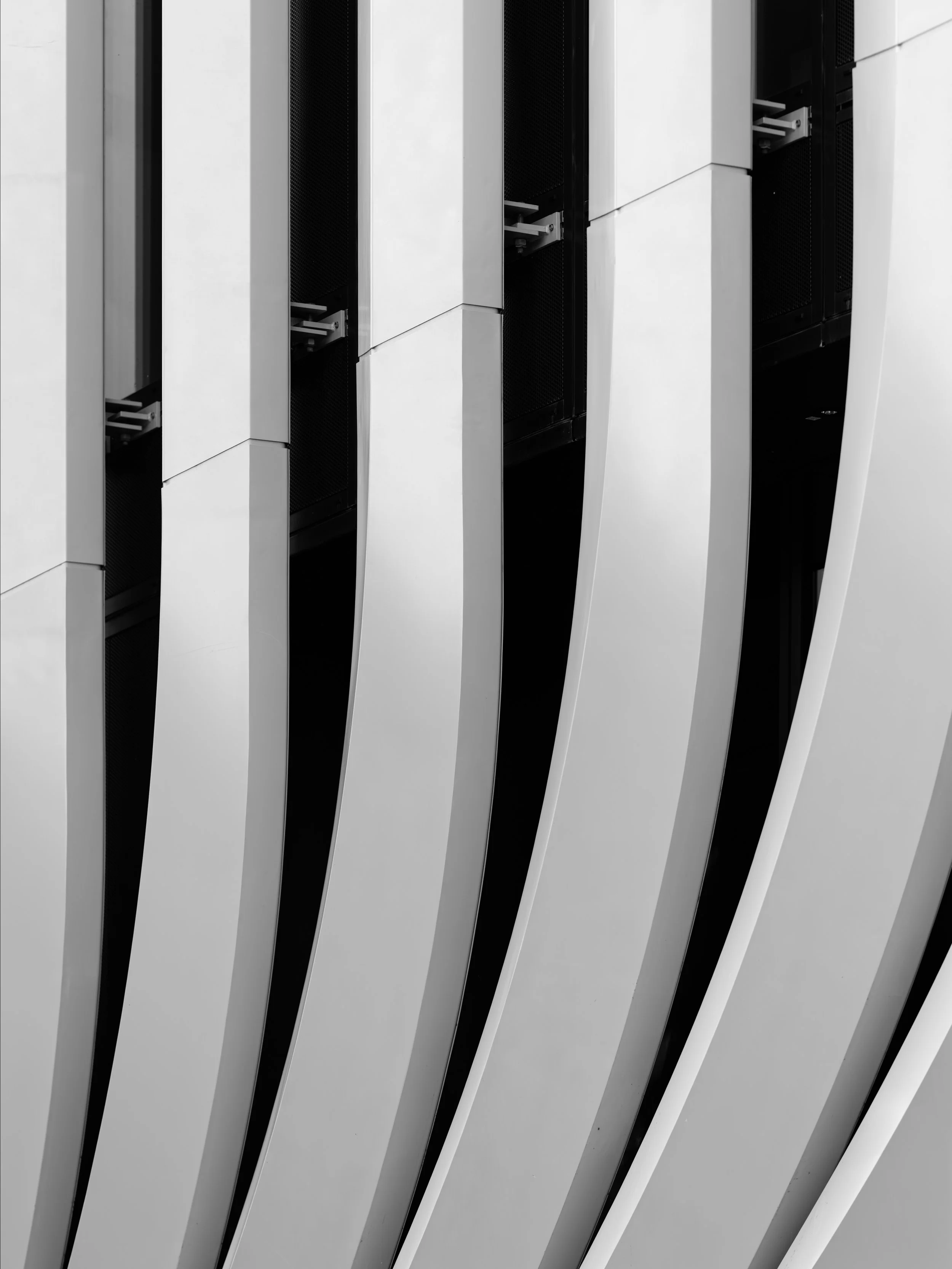
And in black and white, a fragment of a modern building stopped looking like a building altogether and became almost abstract.
That is something I hadn't really expected from this lens. For the type of architecture and minimalism I enjoy photographing, that turned out to be genuinely interesting.
A 200mm doesn't necessarily help you show more. It can be very good at helping you show less.
Compression changes the way you look
This also made me appreciate something else about the focal length.
We normally talk about telephoto compression in relation to portraits. But for urban and architectural photography it can be just as useful.
At 200mm, elements at different distances can appear much closer together. That allows you to build relationships between objects that don't necessarily look connected when standing there. You start looking beyond the obvious subject.
A building in the distance. A tree in front of it. Repeating structures several hundred metres apart. A person isolated on top of a hill.
I found myself walking around Munich looking much further ahead than I normally would.
And that was probably one of the most enjoyable things about using the Sigma.
It made me look differently.
The limitations are very real
None of this makes the 200mm an easy lens to recommend universally. It isn't.
A 70-200mm F2.8 is vastly more flexible. For wildlife, 200mm is often frustratingly short, and on Sony E-mount there is no native Sigma 2x teleconverter solution for this lens.
For portraits, the rendering can be spectacular, but you need space. If your subject is moving around in a relatively confined environment, 200mm becomes restrictive very quickly.
For street photography, it can work (I used it that way quite extensively) but discretion is not really part of the package. Nobody is going to mistake you for someone casually checking their phone.
And for travel, there will inevitably be a moment when you look at your camera bag and wonder whether you really want to dedicate that much space and weight to a single focal length.
These aren't theoretical objections. They are the compromises you make every time you take a lens like this with you.
What about the Sony 50-150mm F2 GM?
For me, this is probably the more interesting comparison than a 70-200mm F2.8 because I own Sony's 50-150mm F2 GM.
On paper, the Sony wins the practical argument almost immediately. It starts at 50mm, reaches 150mm, maintains F2 throughout the range and is optically superb. If I left home tomorrow with only one lens and no idea what I was going to photograph, I would take the Sony.
But I'm not sure that's the right comparison. The Sigma isn't trying to be a more useful 50-150mm. Those additional 50mm at F2 change the rendering more than the numbers might suggest. With the right distances, the compression and subject separation at 200mm can produce something the Sony doesn't quite replicate at 150mm.
Not every photograph looks dramatically different. Some do. And those are the reason this lens exists. There is a difference.
The Sony is the lens I would trust to get the photograph. The Sigma is the lens I might choose because I want that photograph.
Two weeks later
When I received the Sigma, I thought I knew what I would use it for. Portraits. Some wildlife. Maybe sport. And, obviously, lots of photographs at F2 to see what the lens could do.
Instead, I ended up photographing a Porsche, a swan, a butterfly, a dragonfly in flight, a surfer on Munich's Eisbach, buildings, architectural details, a stadium, landscapes and the city at night.
Some of those subjects make perfect sense for a 200mm. Others don't. Oddly enough, those were sometimes the most interesting ones.
The fixed focal length forced me to move, to look further away and, quite often, to simplify the frame. That's more valuable to me than discovering that another modern lens is technically excellent. We have plenty of technically excellent lenses.
The lens you don't need
The Sigma 200mm F2 DG OS | Sports remains a specialist lens.
At around €3,500 and 1.8 kg, it isn't an impulse purchase. There are smaller lenses, cheaper lenses and considerably more versatile lenses. For most photographers, there are probably more sensible ways to spend the money.
But Sigma has done something rather impressive here.
It has taken one of the most exotic lens concepts of the DSLR era and made it significantly lighter, substantially more accessible than 200mm F2 lenses traditionally were, while delivering the build quality, autofocus, stabilisation and optical performance expected from a modern professional lens.
The price/weight/size/performance equation is remarkable.
But none of those things is why I would miss it. I would miss what happens at 200mm and F2. The compression. The separation. The way backgrounds disappear. The possibility of taking an ordinary scene and extracting something completely different from it.
I would also miss something I hadn't expected before these two weeks: the way a fixed 200mm made me search for photographs differently. And perhaps that explains why the 200mm F2 has remained one of my dream lenses for so long.
Two weeks with the Sigma haven't made it any easier to justify. I still own a 50-150mm F2 that is more practical for almost everything I do. I still know that 1.8 kg is a lot of lens to carry around Munich. And €3,500 is still €3,500.
The annoying part is that none of that has made me want one any less. Quite the opposite.
There are many perfectly good reasons not to buy a 200mm F2. The problem is that once you've used one, you also know exactly what you're giving up.
Nobody needs a 200mm F2. Until they use one.